Lumbar traction stretches the lower back by applying a horizontal pulling force across the lumbar spine. The user lies on a flat surface while a thoracic harness anchors the upper body, and a pelvic harness connects to the traction mechanism. As force is applied, the lumbar vertebrae are gently separated, taking load off the structures between them (Physiopedia, 2026), a mechanism documented to reduce nucleus pulposus pressure and increase foraminal area.
The key difference between clinical and at-home back traction is control. In a clinic, a therapist sets and monitors the force. At home, a reliable device needs a precise force gauge, a consistent delivery mechanism, and safety features that prevent excessive force. The Saunders Lumbar Traction Device addresses all of these directly.
A prescription is required to purchase this device. Always use it under the guidance of a physician or physical therapist who has determined that lumbar traction is appropriate for your situation.
The Saunders Lumbar Traction Device: Design And Features
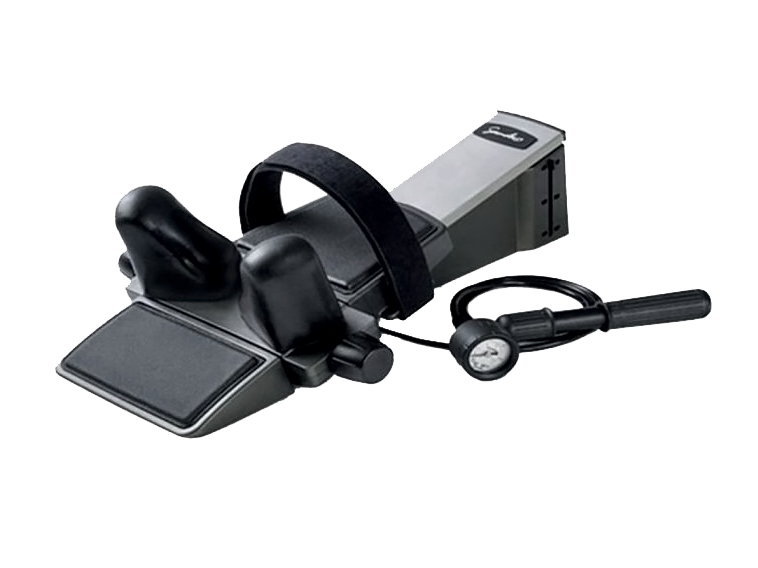
The Saunders Lumbar Traction Device is the first home pneumatic lumbar traction device engineered to deliver up to 200 lbs of controlled force. It was designed to replicate clinical-grade traction in a home setting, and its construction reflects that clinical origin.
The Patented Pneumatic Pump System
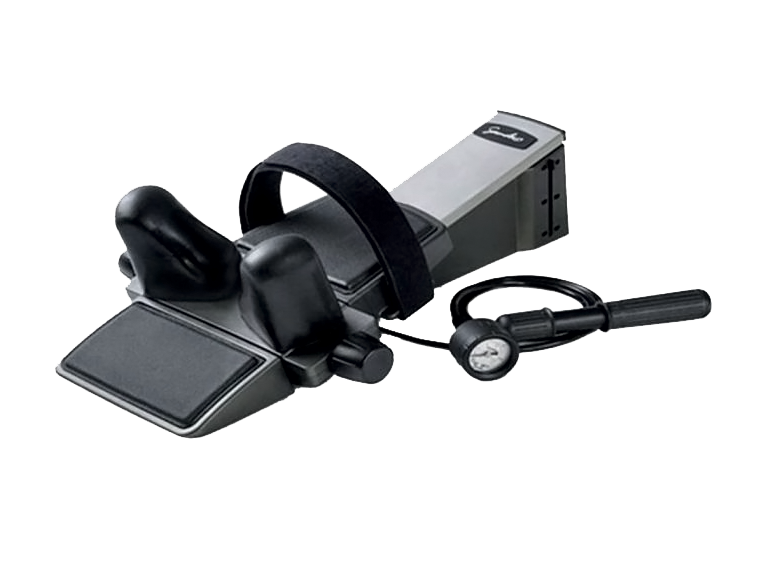
The device uses a patented pneumatic pump with a click-in-place mechanism. The pump allows the user to build force gradually and hold it at the desired level without the pump slipping or losing its connection. An easy-to-read force gauge sits directly on the pump, giving a clear reading of the traction force being applied at all times. A built-in blow-off valve acts as a safety ceiling, preventing the force from exceeding a safe threshold regardless of how much pressure is applied to the pump.
The Split-Table Design
The split-table design is one of the features that most directly replicates what happens in a clinical traction setting (PMC systematic review and meta-analysis, 2023), which documented measurable biomechanical effects of mechanical traction, including vertebral body separation and reduced intradiscal pressure.
As the device applies force, the two halves of the treatment surface actively move apart, creating a friction-free pull rather than a static stretch. This moving surface improves traction by reducing friction between the patient and the device during the separation phase.
Harnesses, Fit, And Setup
The device includes non-slip thoracic and pelvic harnesses with quick-release buckles and integrated belt organizers for fast, consistent setup. Foam wedges are included for head and leg positioning. The device arrives fully assembled and is ready to use directly from its carry case. No assembly is required before the first session.
The carry case doubles as the treatment surface and includes a handle and detachable wheels for portability. The device can be used on a bed or on the floor, making it practical for people with limited floor mobility.
Crucial features include:
- Up to 200 lbs of controlled pneumatic traction force
- Patented pneumatic pump with a click-in-place mechanism
- Easy-to-read force gauge for session-by-session control
- Built-in blow-off valve to prevent excessive force
- Split-table design with actively moving treatment surface
- Non-slip harnesses with quick-release buckles
- Foam wedges for head and leg positioning
- Fully assembled, ready to use from the carry case
- Carry case with handle and detachable wheels
- Can be used on the bed or the floor
- Prescription required
At-Home Back Traction vs. Clinical Traction: What To Expect
A home lumbar traction device replicates the mechanical process of clinical traction, but the setting and supervision differ. In a clinic, session frequency, force settings, and duration are managed by a physical therapist. At home, those decisions follow the protocol your care provider sets before you begin.
This is why starting without professional guidance is not advisable. A physical therapist will determine the appropriate starting force, session length, and frequency based on your specific situation. Initial sessions are typically short, three to five minutes, to allow the back to respond before progressing.
The Saunders device makes consistent, session-to-session replication easier through its precise gauge and pump mechanism. Once your care provider has set your target force, you can reproduce that setting reliably at each session.
Saunders Lumbar Traction: The Saunders Lineup At Ortho Bracing
Saunders makes both lumbar and cervical traction devices, and we carry both. The Saunders Cervical Traction Device with Case addresses the cervical spine using the same pneumatic approach and is designed for consistent, controlled at-home use.
For people managing lower back and neck concerns together, using both devices as part of a broader spinal care routine is a practical option when directed by a care provider. Our
traction collection covers our full selection of traction products. Our
cervical traction device collection covers cervical-specific options in more detail.
Lower Back Traction And Broader Back Support
A lower back traction device addresses the lumbar spine through applied force. It works alongside other tools depending on your care provider's recommendations.
For people who also use a back brace for lumbar support during daily activity, our
back brace collection covers the full range we carry. If lower back support following a spinal fusion is part of your situation, our resource on
how long to wear a back brace after lumbar fusion covers the post-surgical wear guidance. Our
best back brace for lower back pain collection is a useful starting point for curated brace options.
Sources:
- Lumbar traction. (2026). Physiopedia. https://www.physio-pedia.com/Lumbar_Traction
- The effects of the addition of mechanical traction to physical therapy on low back pain? A systematic review with meta-analysis. (2023). PMC. https://pmc.ncbi.nlm.nih.gov/articles/PMC10151852/